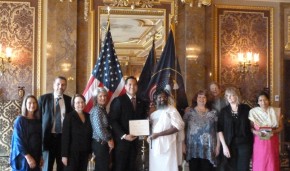
Salt Lake City, UT – On May 19th Thursday, UPF Utah Executive Director Wendy Stovall was invited to a meeting between His Holiness Vasanth Vijay Maharaj and Sean Reyes, Utah Attorney General as a member of the Salt Lake Interfaith Roundtable. Stovall reported that “I learned from some material that I received prior to the visit that His Holiness is an Ambassador for Peace. He told me that he had received his Ambassador For Peace appointment at the House of Lords in London, and he is willing to help as much of possible in our work.”
He is scheduled to visit New York between May 28 and June 3 to attend some events at the United Nations.
ABOUT HIS HOLINESS VASANTH VIJAY MAHARAJ
The futuristic Spiritual Power who has transformed the lives of millions by his teachings and inspired numerous followers across the globe with his universal message of harmony, unity and brotherly love is none other than His Holiness Dr.Vasanth Vijayji Maharaj, the most renowned and prominent religious leader from India who is a “Living Legend of Ahimsa and Non-Violence”.
At a very young age of 20, His Holiness quit all worldly pleasures and attained Sainthood. His Holiness is a great spiritual master who has practised deep meditation and strict penance for more than 20 years in the dense caves of Himalayas to deep mountains of Vimlachal in India and has attained the most rarest and highest form of “Aatmadhyaan and Kundalini Jagran” with the opening of all the chakras and possessing the eternal force to bless success to one and all. His Holiness is beyond astrology or any foreteller like the famous Nostradamus. He is a numerologist of the highest kind and his powers are remarkable. All the world’s renowned dignitaries, religions heads, scholars, politicians including Presidents and Prime Ministers of different countries have visited the International Peace Centre in Krishnagiri, India to seek his immense blessings and experience the eternal joy and harmony surrounding him and his holy place. An aura film made on His Holiness clearly revealed the rarest rays produced in any human body to date.
His Holiness is the first Indian saint to be appointed as the Ambassador of Peace by the Universal Peace Federation and is appointed as the Diplomatic Consular from India by the International Parliament of Safety and Peace and holds a diplomat passport. His Holiness is honoured with 9 Guinness World Records and 5 Limca World Records for his Commendable contributions to peace promotion for the past 25 years. Besides being the winner of the Public Peace Prize in 2015 and an esteemed nominee for the most prestigious Nobel Peace Prize in 2011, His Holiness have received several honours, titles and achievements for His stupendous works until today.
His Holiness have always promoted larger peace and traveled all around the world taking his peace mission. His revolutionary launch of making Peace Education as a compulsory subject in school curriculum have gained great momentous and welcomed by all from the Pope of Vatican to the world’s renowned peace scholars, by the governments of different nations to the local counties and common public. He has drafted the five point agenda on peace education explaining the role of different sections of the society: 1. Role of Policy Makers; 2. Role of Principals; 3. Role of Teachers; 4. Role of Parents; and finally the 5. Role of Children. He is one of kind Holy men whose life ambition is to see a peaceful world.
It is hugely reassuring that while the world goes about its business, there is somebody like Dr. Vasanth Vijayji Maharaj constantly worrying about its wellness.
Las Vegas, NV – A peace forum was held at City Hall over the noon time hour on May 18th supporting the concept of “Strengthening Marriage and Family” with fifteen (15) people in attendance commemorating the United Nations International Day of Families.
After a prayer given by Rev. Jerushia Hylton, Pledge Allegiance led by Mr. Jim Rigney and a group singing of ‘God Bless America’. A short movie clip introducing UPF was shown. Mrs. Leslie Rigney then gave a short presentation on the Marriage and Family Peace Principles.
The main program was a panel discussion, entitled “How to Seek, Find and Keep a Loving Lasting Relationship” moderated by Sera Hirano, Chairwoman for Women’s Federation for World Peace, Las Vegas. Panelists were: Rev. Jerushia McDonald Hylton, with a Christian and African-American background whose great concern is the youth of today; Hope Igarashi, married for 34 years with several grown children representing Family Federation for World Peace and Unification; and Nick Phillips, a husband and father of 2 children, a successful businessman who is now running for Assemblyman in District 41. Questions were put out for answering as panelists wished, with questions about qualities needed for a good relationship, whether dating is helpful, and the value of commitment. After the panelists, questions were taken from participants, with very open and sincere concerns raised.
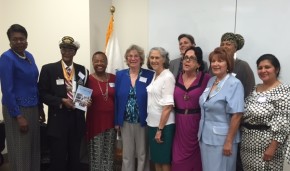
Also present was Arby Hambric, a Veteran of WWII, the Korean War and the Vietnam War. He was very proud of the medal Rev. Moon had given to him. He also spoke of the book he wrote about his life.
Following the formal meeting, lunch was shared with many people staying to talk with each other about many topics. Many thanks to our volunteers and panelists and congratulations to our new Ambassador For Peace, Nick Phillips for his appointment!
Elkton, MD – UPF Washington D.C. supported the celebration of Asian Pacific American Heritage Month program at the Cecil County on Thursday, May 5th, 2016.
In October 10, 1978, President Jimmy Carter signed House Joint Resolution 1007 declaring May as Asian Pacific American Heritage Week beginning May 4, 1979. Then in 1992, Congress passed Public Law 102-450 which annually designated May as Asian Pacific American Heritage Month.
The month of May was chosen to commemorate the immigration of the first Japanese to the United States on May 7, 1843, and to mark the anniversary of the completion of the transcontinental railroad on May 10, 1869. The majority of the workers who laid the tracks were Chinese immigrants.
Asian Pacific encompasses all of the Asian continent and the Pacific islands of Melanesia (New Guinea, New Caledonia, Vanuatu, Fiji and the Solomon Islands), Micronesia (Marianas, Guam, Wake Island, Palau, Marshall Islands, Kiribati, Nauru and the Federated States of Micronesia) and Polynesia (New Zealand, Hawaiian Islands, Rotuma, Midway Islands, Samoa, American Samoa, Tonga, Tuvalu, Cook Islands, French Polynesia and Easter Island).
The celebration program was organized by UPF Ambassador for Peace Mie Mie Joe Strickler, a Commissioner appointed by the Governor’s Commission on Asian Pacific American Affairs, Governor’s Office of Community Initiatives (GOCI). Over 100 Asian residents in Cecil County and neighboring areas gathered at the Cecil County Administration Building to celebrate the Asian Pacific American Heritage Month.
The guest speakers were: Mrs. Yumi Hogan, Maryland’s First Lady; Mr. Jon C. Wobensmith, Marlyland Secretary of State; Wayne Norman, Senator of District 35, Cecil and Hartford Counties; and Christina W. Poy, Administrative Director, Governor’s Commission on Asian Pacific American Affairs, GOCI.
UPF Washington, D.C. through its Executive Director, Tomiko Duggan with some staff put up a Japanese display table and offered sweets to guests.
Contributed by: Tomiko Duggan, Executive Director, UPF Washington D.C.
Seattle, WA – The Universal Peace Federation in the State of Washington held it’s monthly Peace Forum on April 28, 2016 at the Windermere House in partnership with the Ambassadors for Peace Association of Washington State (AFPAWS).
Mr. Raymond McCready, the Executive Director of UPF Washington welcomed all Ambassadors For Peace (AFP), friends and new guests. After a wonderful dinner fellowship, McCready introduced and appointed a new AFP, Mr. Alex Iheme, who is originally from Nigeria. Mr. Iheme explained how he was involved in public service in Nigeria, and so having emigrated to the USA to enjoy the many opportunities, he found the UPF online as he searched for an organization with whom he could work for public service in the state of Washington.
After the dinner, McCready shared the discussion subject of the forum: “Under the worldview that Humanity is One Family Under God, what is the Position and Mission of the USA?”. He then read some quotes related to discussion question from George Washington, Abraham Lincoln, Martin Luther King Jr. (from “The American Dream” sermon, 7/4/1965), and UPF founder Rev. Dr. Sun Myung Moon. Dr. Moon’s quote was a section of his speech on June 1, 1976 entitled “God’s Hope for America”.
After going through the quotes, they then rearranged the audience and created three discussion groups. Each of the group discussed on the question “What is you thought concept on the position and/or mission of the United States of America?” After discussing, each group assigned a representative who reported for the group.
In summary, here are the general conclusion of all the three groups: Group 1 concluded that America has been blessed by God, and has a responsibility to share those blessings with the world; Group 2 concluded that the mission of the USA is to recognize and receive God as the Parent of Humankind, under the key theme of Godly Family Values; and Group 3 concluded that at times the USA should focus on being a model for the world, so we are able to raise up other nations.
The forum was coordinated by Mr. Raymond McCready and Mrs. Yuko Faris, Assistant AFP Program Coordinator. AFP Mrs. Emma Herron served as the emcee.
Contributed by: Ray McCready, Executive Director, UPF Washington State
Washington D.C. – A gathering of over 70 people in the Founder’s Room at The Washington Times Sunday April, 24th was full of energy and interest as the seven panelists each gave their passionate insights into peace building in Pakistan. Recent tragic events in Pakistan, including the murder of highly-respected Soran Singh inspired this gathering. Dr. Singh was a Pakistani Sikh doctor, TV anchor, politician and Minister of Minorities of Khyber Pakhtunkhwa. Before joining Pakistan’s political party Tehreek-e-Insaf in 2011 (Pakistan Movement for Justice is a third way communitarian political party which aims to create a welfare state, where the state is responsible for education, health and employability of citizens. Its ideology is based on promoting complete freedom of thought, abolition of personal income tax and dismantling religious discrimination in Pakistan), he was a member of Jamaat-e-Islami Pakistan (a socially conservative, Islamist political party working toward creating an Islamic state in Pakistan) for nine years. He joined the JI in an effort to bring peace to Pakistan. Dr. Singh was appointed as an Ambassador for Peace five years ago in Pakistan. A moment of silence was offered by all in his memory.
Mrs. Tomiko Duggan, Executive Director of Public Affairs, UPF USA – Washington, DC introduced the work of UPF through a short video and then brought forward, Dr. Zulfigar Kazmi, Executive Director of The Commongrounds, USA, MC and co-sponsor. He is also the Vice President of the China – American Friendship Foundation which focuses on the relationships between the US, Pakistan and China.
Dr. Kazmi introduced the first speaker, Mr. Victor V. Gill, President, Christian Voice of Pakistan. He has lived in the US for 40 years. He asked, “Is religion part of the solution or part of the problem? Both.” Conflicts began at the beginning of time with Cain and Abel, he added. God hoped that Cain would change his mind and not fight with his brother, but he didn’t overcome, he said. He asked, “Did these brothers have a religion? Yes,” he said. So do terrorists who kill others without knowing they are brothers, he concluded. He explained that all people have a motivation or chip inside that pushes each of us toward respecting religion and God, yet many feel Schadenfreude happiness when the other side loses more people than we do. In the Holy Koran, Sura 5:32“If one person is killed it is too many.” Killing is not for the people who believe in God, he added. Religion is like a medicine; it can heal us and give us value. But if you take too much of it, like a holy roller, it becomes toxic. Medicine bottles say: Keep out of reach of children. This is true for extreme religion too, it is unhealthy, he concluded.
The next speaker was Mr. Manny Manawar Alam, President of the Pakistani American Congress (PAC). He is the first Christian to become it’s president. He began by saying that to bring everyone together under one umbrella for peace is monstrously challenging. He noted that the US was going to sell Pakistan F16 fighters but when 74 Christians were killed in the streets, with 134 injured, the deal was held up due to the lobbying of those who feel it is not safe for minorities in Pakistan. He said that we need a win-win situation for US – Pakistan relations. He added that there are many efforts ongoing to make peace, including interfaith dialogue. He feels that Pakistan needs secular schools like Indonesia and the Philippines; and women and youth need to be involved in tolerance teaching like in Thailand. Many Hindu organizations are influenced by the peace teachings of Ghandi, he added. American Jewish fellowship, the American Friends Committee and others are working toward peace in Pakistan. He concluded with: “No religion will bring peace; it is you and me who will get the job done!”
The third speaker was Javad Ali, an Ambassador for Peace in Pakistan. He is a TV reporter and a Muslim. He has been visiting the US for 14 days and is working on his Ph.D. He said that after 1980 a group emerged that is called Zia’s children, who claim to be the main jihadists. When he studied in school, it was Dinyat (all religions) taught respectfully and not as radicalized as it is today. Now the Sunni based Islam has become political, he said. The radical curriculum is funded by the UK AID, and US AID, but they don’t know what is being taught or what is written in the textbooks. The West is paying for the radicalization of Pakistan and doesn’t know it, he added. The reality is only Muslims can become government leaders. Minorities make up 20% of the population and none can hold positions of influence, he said. His hometown was always integrated and thus peaceful, he said. He stated that all of Pakistan needs a non-radicalized curriculum; he concluded, “We do not need a religious war but a war of ideology.”
The fourth speaker was Douglas Burton, a former U.S. State Department official in Iraq. He was also a press member while serving in Kirkuk in May of 2007, while the US and Iraq were gaining ground against Al Qaida. He stated that genocide against minorities in Iraq and Syria is ongoing. “We need to get out of the mindset of denying the link between Islam and radicalism, the ones who are fighting are Muslims,” he stated. The 2.5 million Christians have historically been mediators between the Shi’a and the Sunnis, we need them to continue to play that role in Iraq, he added. But there is extreme genocide against the ancient Chaldean Christians, Mandaeans, Yazidis, and Assyrians. [August, 2014 ISIL attempted ethnic cleansing against the Yazidis and the Assyrians.] He continued saying that there are two million refugees in the Kurdish area now due to the fighting. There are 360,000 Christians, who are the most educated leaders, are struggling to survive. Many minorities have tried to leave the country, he added. Now there is an effort to create a safe zone in the Nineva plain, near the Tigris River around Mosul. It is 14,000 square miles of space. This is in the Kurdish held area. But the problem, he said, is that this area has oil fields; Iran and ISIS and Syria want this area for its richness, so does Baghdad, he added. He said emphatically, “Radical Islam needs to be clearly known not denied.” The governments in the world can do much to help this struggle, in the US Congressmen Fortenberry and Eshoo have been working to help relieve this crisis, he added. The US Defense of Nation Act is arming the militias in the area, they will defend their own area and then the economy can begin to develop, he said. Private organizations can engage with NGOs and other organizations or groups to aid Iraq, even churches can adopt another church in Mesopotamia, he added. “We need to win the war of ideas and remove a totalitarian regime,” he concluded. While he was in Kirkuk he used his experience of being a Boy Scout leader, to help the Boy Scouts and Girl Scouts in the area to connect to the US organizations for exchange of ideas, uniforms and badges and to secure a non political base for these social groups to work, allowing all Iraqis, regardless of religion or sect to work together in a healthy way.
The fifth speaker was the only woman on the panel, Hali Jilani, Director of the Institute of Cultural Intelligence. She is a well-educated Afghan and Muslim, who has served as an aid worker, a military advisor and has educated US soldiers in Afghanistan, Iraq and Pakistan about the cultural needs of the people and how to reach the indigenous leadership to bring peace. She said, “We need to protect the minority rights, the topic today is dear to my heart.” She reported that the CIA made a mistake when they brought in Saudi advisors who were radicalized and then set up the Taliban foundations that later crushed the natural culture of Afghanistan, which is quite different than the Wahabi-style of Islam. They are not natural allies, they had their own political agenda, she added. The religious traditions of the area are ancient, Cyrus the Great, a Zoroastrian, 500 BCE, stated that ‘no religion is superior to another.’ After he invaded a country he allowed the people to keep their own religions and worship their own gods. Maimonides is another inspiration for the area; he was a uniquely gifted Jewish teacher. He spoke so well about religion that the narrow-minded Christians and Muslims didn’t allow him to speak again for fear that he might convince others of his views. “Each religion is valuable,” she said. When bad leadership tries to remove the ideas of another it creates a power vacuum, the greed of some ‘play the God card’ to fill the vacuum and try to address the pain that people have suffered but then dominate them and cause more suffering, she said. Thus the Taliban were accepted at first because they offered help after the Russians were driven out. Interfaith is essential, “we need to understand and respect the beliefs of others,” she concluded.
The sixth speaker was a 16 year old student; Abbas Ali is a high school student studying at St. Anselm’s Abbey School in Washington, DC. His father is a strong Shi’ite, his mother is a Jew and he was born on Christmas Eve and attends a Catholic school. His parents are now divorced, and he is Jewish, and is working to spread “Intercultural Competency.” His grandfather was a famous Islamic teacher, Johiri. He wishes to understand other religions so that he can help bring peace to the world. He speaks Urdu, Arabic, and is studying Latin, French and Hebrew. He also attends UN conferences to learn what the situation in the world is. His father was extreme in his thinking; he disliked all other religions except his own Shi’ite Islam. Abbas believes that there is no productivity in meaningless hatred. His protestant great grandmother helped Jews escape the Nazis during World War II. He now understands Christianity much better and sees how religions can work together, he said. “It is rare for a religion to solve religious conflicts and acts of violence,” he added. Many conflicts are the result of economic, political or cultural problems not just religions, he said. All religions do have humanitarian aspects, but the Taliban has not shown theirs yet, he commented. He said “A secular approach is needed now.” Ignorance of the other is the real problem. We need to use the ‘spiritual approach’ first, producing low violence; then the ‘secular approach,’ but if both fail only then should we use the military approach because a military effort will fuel violence and stir up negative passions, he said. A broad educational system must promote love and respect for all; and peace makers need to be diverse ethnically, age-wise and religiously, he concluded.
Alex Cromwell was the final and seventh speaker. He is an instructor at the School of International Service, at American University in Washington, DC. He is working on his Ph.D. at George Mason University, VA in Conflict Resolution. He works with the youth to create ways for divergent groups to get to know one another and through relationships old biases are replaced by personal experience which engenders understanding and tolerance. He said that “peace begins within ourselves.” Pakistan is suffering so much conflict due to religious narrowness, “when a religion focuses on being “chosen” problems arise because other religions are “less chosen” than yours, indicating your superiority over others, he said. “My God verses your God,” kind of thinking, he added. “We need to change the lens we are looking through,” he said. He works to bring youth together to meet the “other,” and get to know that the feelings, desires and goals of the “others” are just as valuable as one’s own. The new relationships that are made create change and an attitude shift, he said. He read several reflections of students who came to the US and got to know Americans. One Muslim was moved by the tears of a Native American who spoke passionately about his beliefs, whereas before the Muslim was taught that all non-Muslims were going to hell. He was also moved by the mother of the family he was staying with as she prayed sincerely with tears. He decided that such a loving, kind and sincere woman was definitely not going to hell. Another Muslim felt shame because previously he had felt happy at the catastrophe of 9-11 in New York, because he believed that the US was a bully and a terrorist country. But when he heard that those people who lost loved ones during that time had actually forgiven the Muslims he was sorry for his ignorance and stated that “Now I can appreciate anyone wherever I go in the world.” Mr. Cromwell said that when a young person has exposure to other types of believers it can create good relations and open the mind to more reasonable thinking. He teaches that attitudes change from relationships, beliefs are good and bad everywhere, but we are all human beings. And behaviors shift to practice tolerance and understanding.
Following the program, new Ambassadors for Peace were appointed by Susan Fefferman, the AFP coordinator for the DC area. The seven new appointees are: Mr. Umar Farooq, founder and CEO of NEXT TV, a Lifestyle program that collaborates with The Commongrounds; Ms. Sadaf Shahid who has been instrumental in promoting interfaith dialogue in Virginia. She hosts an Annual Women’s Peace Conference; Mr. Mazhar Chughtai, is a leading Pakistani-American businessman and educator who supports educational and health programs in Pakistan. Also appointed were speakers: Abbas Ali, Alex Cromwell, Manny Alma, and Victor Gill.
Contributed by: Tomiko Duggan, Exec. Director UPF Washington DC
San Francisco, CA – On Saturday, April 23rd the Universal Peace Federation Northern California had the pleasure of having Jeff Scharfen as the guest speaker for the monthly Community of Faith Breakfast.
Mr. Scharfen talked about the “The Importance of Keeping an Open Mind”. Jeff, who is a distinguished English teacher as well as peace activist, utilized words of Father Moon, Jesus Christ, Yeats, Shakespeare and Dante, all weaved into a very heart felt message of the need to bring hope, forgiveness and redemption to all people.
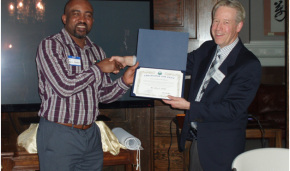
At the conclusion of his speech, Jeff Scharfen was appointed as an Ambassador For Peace.
Contributed by: Kevin Thompson, UPF Northern California Chairman
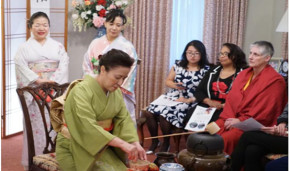
Washington D.C. – In the most beautiful time of the year in Washington, DC, the Japanese Tea Ceremony was held at the Peace Embassy on April 21, 2016. The driveway and entrance to the UPF Peace Embassy was cooled with water to welcome the guests which signifies purification of the surroundings of the “Tea House” as the guests arrived. The guests were then greeted at the entrance door by a Kimono-clad hostess.
The hall of the Peace Embassy was transformed into a Japanese tea house for the occasion with many festive origami pieces and art from Japan. A delicious Japanese dinner was served afterward.
Over 40 guests, diplomats from the Embassies of Russia, Lithuania, Pakistan and the Bahamas, NGO leaders and friends of UPF in the Washington, DC community attended the ceremony.
Tomiko Duggan, Executive Director of Public Affairs of UPF USA introduced the guiding vision and the founding principles of Rev. Sun Myung Moon, the Founder of the Universal Peace Federation, which is to build a world of peace where all people from different cultures, races, nationalities and religions can live as true brothers and sisters, as “One Family Under God” by practicing the universal principles of “Living for the Sake of Others and for the Whole.”
She explained at the tea ceremony that the way of tea is to serve others. What we learn in the “Way of Tea” is how to live in harmony and, to develop the attitude of respect toward others and all things, to have purity, honesty, truthfulness, and sincere emotions to obtain tranquility of heart.
Before the ceremony was conducted, UPF USA – Washington, DC appointed two persons to become “Ambassadors for Peace.”
Susan Fefferman, “Ambassadors for Peace” program coordinator, emphasized that the appointment to be an “Ambassador for Peace” is not for what you have achieved; this is an appointment to become the conscience of society to bring spiritual and moral principles to the tasks for resolving problems of our world.
The first recipient was Ms. Beverly Ezeokoli, born in Trinidad who migrated to the United States at 13 years old. She graduated with a (BSW) Bachelor of Science in Social Work from Southern Connecticut State University in 1984. She worked for the City of New Haven in the Welfare Department for almost ten years, as a Social Investigator/Social Worker, and presently is employed by the Montgomery County School System as a Para- educator.
Ms. Katrina Johnson, a native of Richmond graduated from Howard University earning a Bachelor’s of Science Degree in Interior Design and Architecture, with a primary focus in micro-environmental studies. She believes true wellness is achieved by nurturing the mind, body, spirit and soul with the natural gifts God blessed us with, and helping others to do the same.
The guests from different cultures and nationalities enjoyed the ceremony and experience of Japanese customs and different social etiquette. The guests stayed long after the ceremony talking with one another and sharing an enjoyable time.
Contributed by: Tomiko Duggan, Executive Director, UPF Washington D.C.
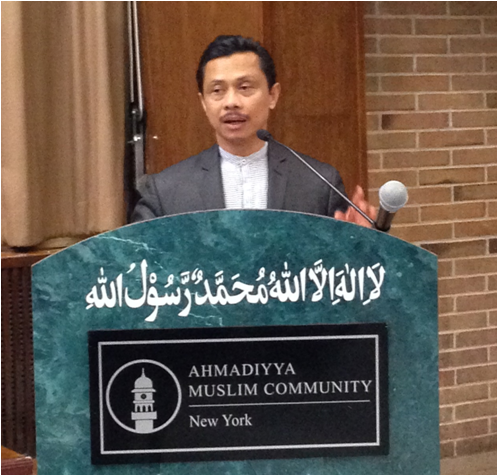
Hollis, NY – More than a hundred people gathered at the Bait-Uz-Zafar on April 3rd from 3 – 5 PM. Although it is a Sunday, where most people are having services on their own houses of worship yet the Ahmadiyya Muslim Community hosted an Interfaith Conference inviting major religious groups and interfaith advocates.
UPF USA President Richard De Sena was invited to be one of the seven panelists representing different faith traditions. The discussion was hinged on the topic “Religious Teachings and Contemporary Challenges”. Other government officials were also invited including NY Assemblyman David Weprin, NYC Councilman Barry Grodenchik.
Also one prominent Muslin in New York City Imam Shamsi Ali, Chairman of the Al-Hikmah Mosque and Director of the Jamaica Muslim Center, the largest Muslim center in Queens area who served as the conference moderator was among the guests during the conference. Imam Ali was appointed “Ambassador for Peace” by the International Religious Federation in 2002, and a recipient of the 2008 ICLI Interfaith Award.
De Sena testified on the very successful interfaith works of the Rev. Sun Myung Moon and Dr. Hak Ja Han Moon through the Universal Peace Federation. He shared the core values and areas of work of UPF in America.
The participants coming from diverse communities listened attentively to the speakers and made strong determinations to practice the great teachings that they learned at the conference.
Contributed by: Richard De Sena, UPF USA President
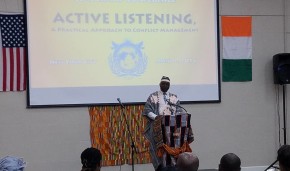
New York, NY – The Universal Peace Federation Office of African Affairs hosted the “African Diaspora Leadership Conference” through its Executive Director Drissa Kone on March 26, 2016 at the FFWPU Learning Center in the heart of Manhattan.
Key government, civic and religious leaders of the Ivorian diaspora community in New York were present to support the work of Mr. Kone. At the conference, he reported the primary finding from his doctoral research entitled: “Active Listening” is the key to strengthening relationships and resolving conflict. His paper aims to understand and resolve conflicts as a result of civil wars in his native country, Cote D’Ivoire, through active listening towards genuine reconciliation. “My studies showed me that this was the practical way to love sacrificially, even when we, ourselves, are hurting. We often feel like we have to say what we think is right, but we often do this at the expense of our relationships. I realized that I have to listen first to understand. If we don’t understand, we can never love and we can never achieve peace.”
Most of the Ivorian civic and religious leaders in attendance at the conference had participated in Mr. Kone’s doctoral research on the efficacy of active listening as a source of conflict resolution over the past few years. Mr. Kone had reached out to them one by one to invite them to share their hearts and stories, seeking simply to understand rather than to be understood. For Mr. Kone, the conference itself represented the fruits of his research. He was able to gather Ivorians of different ethnicities, religions, and political affiliations—all touched by the violence of the civil wars in some way—together in one room through the mutual trust and love he had built by actively listening.
Honorable Christophe Kouaou, the Consul General of Cote D’Ivoire to New York who gave a congratulatory remarks said “To you, my young brother, Mr. Kone, I would like to say I am particularly proud that you recognize the value of forgiveness. That is the foundation of all social life, all community life, both in the diaspora and the Ivorian nation. To you, the leaders of the Ivorian diaspora, I invite you to make the work that our brother has done your own. Please make that work your own. To all the advisors and professors of Mr. Kone, I would like to express my gratitude for supporting him and, by extension, the Ivorian diaspora and nation.”
Also, Imam Souleymane Konate of the Majid Al-Aqsa Mosque in New York also commented, “I’m so proud of this young man because the project is a very productive one and he did a good job. Bringing all these people together is a great accomplishment, and the presentation itself was also great. I was sharing with some of the leaders just now, ‘Drissa started it. Let us finish it.’ The choice Drissa gave us today, if we act on it, we will definitely bring our people together in love, peace, and harmony.”
Supporting the report of Mr Kone is a video and brief presentations by Rev. Richard De Sena, President UPF USA on the topic of reconciliation. He said, “the Co-Founders of UPF, Rev. Sun Myung Moon and his wife Dr. Hak Ja Han Moon always tried to find ways to bring harmony, reconciliation, and ultimately, peace andlove.” Furthermore, he praised Mr. Kone and the participants saying, “It was great to see Ivoirians of different ethnicities and religions coming together in an environment of tolerance, respect, harmony, and, I would say, love. Mr. Kone has accomplished a great work of peace today.”
Twenty (20) new Ambassadors for Peace were appointed at the conference which was handed by Rev. De Sena, Mrs. Lynn Walsh, Director of UPF International Office of Marriage and Family Education and Co-chair of the UN’s NGO Committee on the Family in NY and Mr. Kone himself. Afterwards was the signing of a “Peace Charter of the Ivorian Diaspora in New York”
The event was co-hosted by the Unification Theological Seminary (UTS) where Mr. Kone is completing his final year on a Doctorate of Ministry program with concentration in peace and justice.
Contributed by: Emiljun Rapada, UPF USA with reports from Mi Young Eaton, UTS